Essential Skills Every Arborist Needs
So, you’ve mastered the basic knots, you know your way around a chainsaw, and you aren’t afraid of heights. But if you want to transition from a rookie who just "cuts wood" to a true professional who manages trees, you need to level up your toolkit.
To stand out in the canopy, these are the essential skills you need to master.
Advanced Tree Biology (The "Why" Behind the Cut)
Anyone can swing a saw, but a great arborist understands the consequences of every cut. You must develop a deep grasp of tree biology—knowing specific growth requirements, predicting growth rates, and reading structural patterns.
The Long Game: Don't just prune for how the tree looks today. Predict how it will respond in five seasons.
The Payoff: Understanding compartmentalization (trees don't heal, they seal) ensures your work promotes long-term health rather than triggering a slow, structural decline.
High-Stakes Rigging and Physics
When you’re dropping heavy timber in tight urban spaces, guessing is a liability. You need to master the technical, heavy side of the job by understanding the extreme physics at play.
The Math in Action: Understand that a 200lb log dropped just 2 feet onto a static rigging line can easily generate over 1,000 lbs of force—turning a standard rope into a dangerous slingshot.
Precision Control: A rookie drops and prays; a pro uses friction ratios and mass calculation to make massive logs dance exactly where they want them.
Precision Climbing and Aerial Rescue
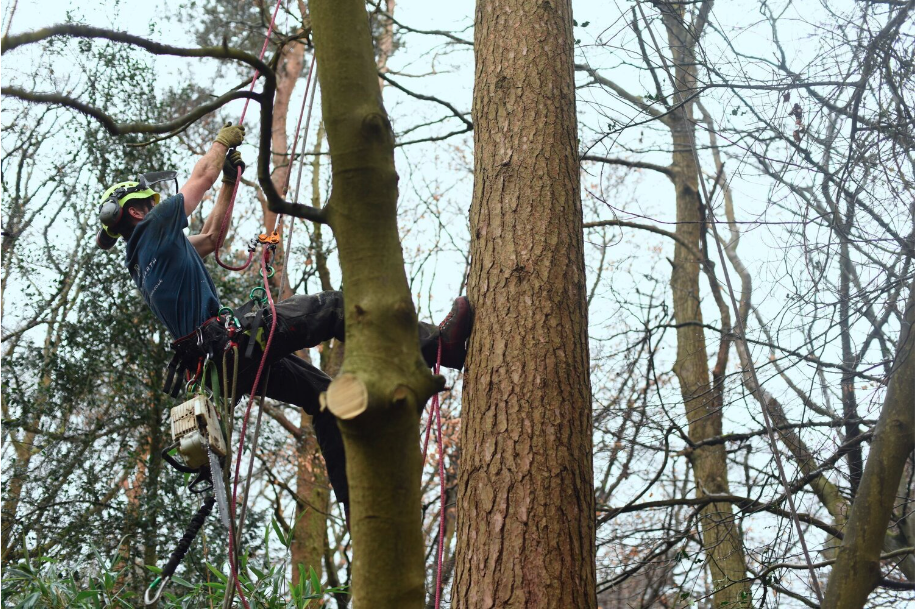
If your climbing technique relies on pure adrenaline and muscle, you’ll burn out before your career even starts. True professionals master modern climbing systems (SRS/MRS) to save their energy and protect their joints.
More importantly, you must be flawless in your aerial rescue protocols. You aren't truly qualified to climb a tree until you are fully competent in bringing a compromised partner down safely. This is exactly why professional training centers, like the DTE Academy, treat aerial rescue as a mandatory baseline rather than an elective. If you want to know how to become a certified tree surgeon but don't know where to start, you can take your first step into the canopy by calling DTE on 01959 524 623 or emailing enquiries@dtetrees.co.uk.
The Bottom Line: Don’t just be a mechanic of the forest. By blending deep biological science with precise, high-risk technical execution, you’ll transform from a basic tree cutter into an elite asset in the canopy.